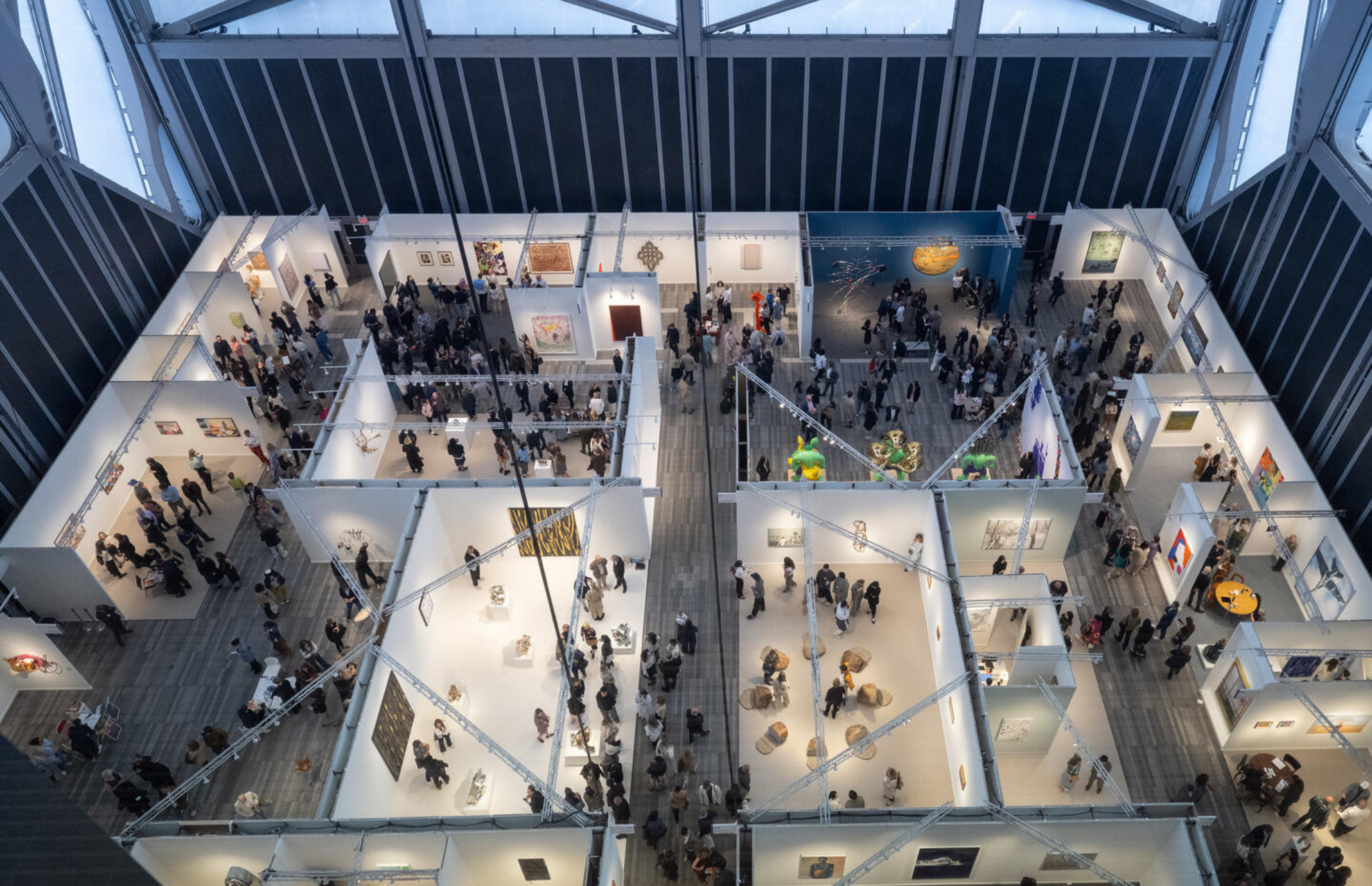
Art Basel’s 2025 edition unfolded with unmistakable intensity—politically, economically, and creatively. Set against the backdrop of global conflict and shifting trade dynamics, the fair saw a noticeable dip in American buyers, while European collectors emerged as key players, making more strategic acquisitions. VIP days were energetic, with mid-tier works selling briskly, even as decisions on higher-end pieces were more cautious in light of international tensions. Still, the fair retained its global stature, attracting 289 premier galleries from 42 countries and territories, presenting everything from early 20th-century modernist works to cutting-edge digital art.
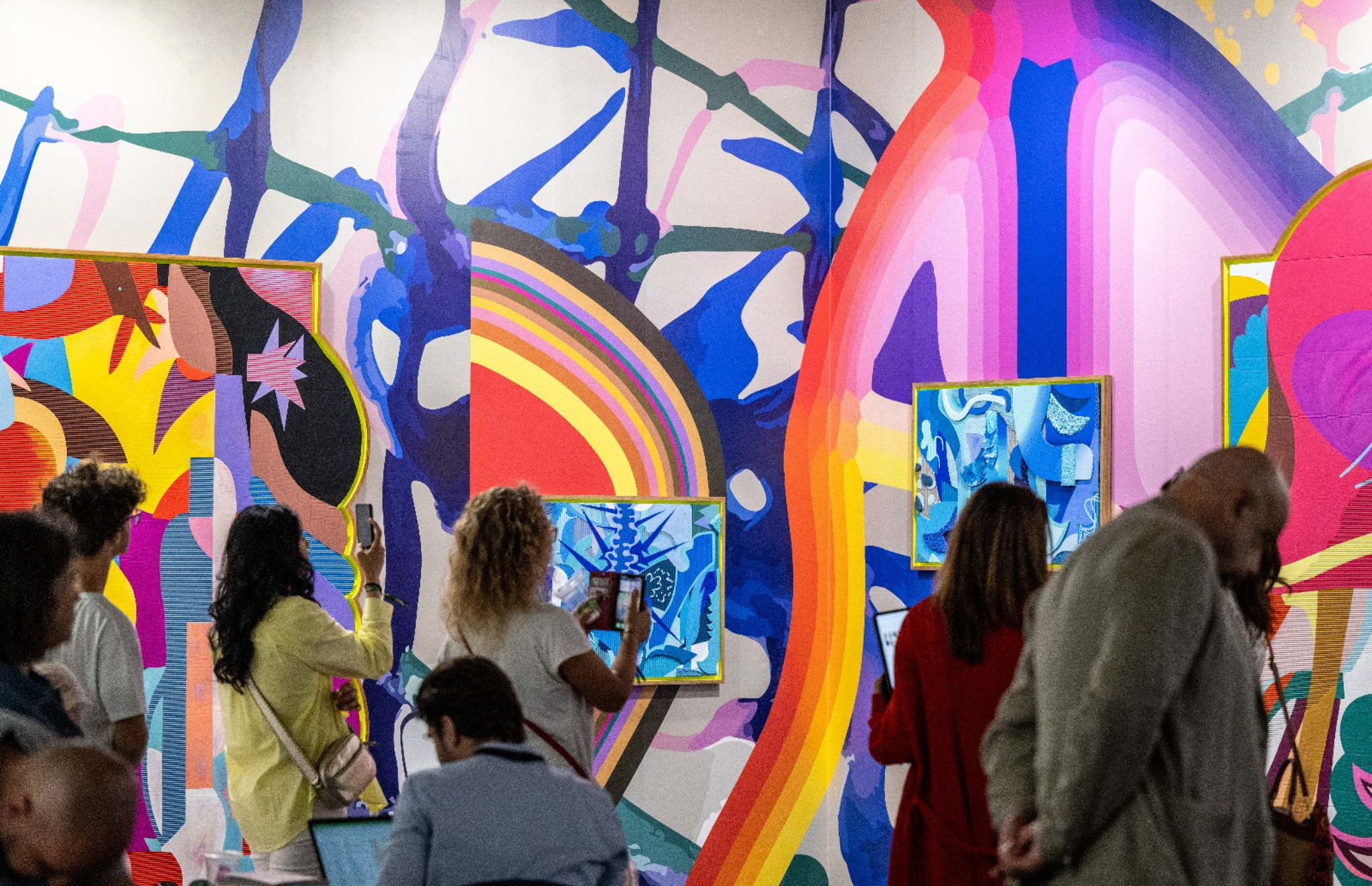
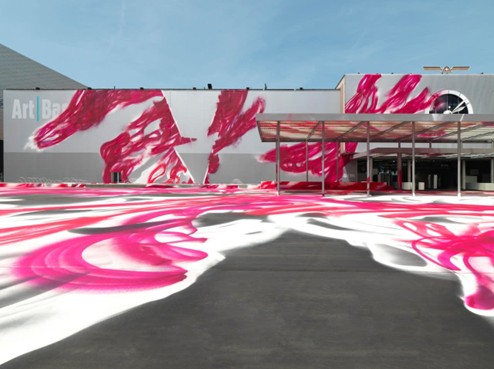
Katharina Grosse CHOIR, 2025, Messeplatz project, Art Basel, Courtesy of Art Basel
This year saw the debut of Premiere, a new sector spotlighting ambitious presentations from ten mid-sized galleries, alongside the return of Statements, Feature, Edition, and Unlimited—which featured 67 monumental installations curated by Giovanni Carmine. Kabinett returned with 24 curated highlights within main booths, enriching the fair’s curatorial depth. A showstopper at Messeplatz was Katharina Grosse’s explosive chromatic takeover, curated by Natalia Grabowska, transforming the site into an immersive, sensorial world. Meanwhile, Parcours, curated by Stefanie Hessler, invited the public to engage with site-specific installations under the theme Second Nature, stretching from Clarastrasse to the banks of the Rhine and even Münsterplatz, forging new links between the fair and the city.
Beyond the booths, Art Basel launched its first-ever Art Basel Awards, in partnership with BOSS—celebrating visionary voices from across disciplines with 36 medals and a headline-making summit on June 20. From curated sectors to public programs and institutional collaborations, the 2025 edition of Art Basel affirmed its role not just as a marketplace, but as a barometer for where the art world is headed next. The fair once again lived up to its legacy of “Basel brilliance.”
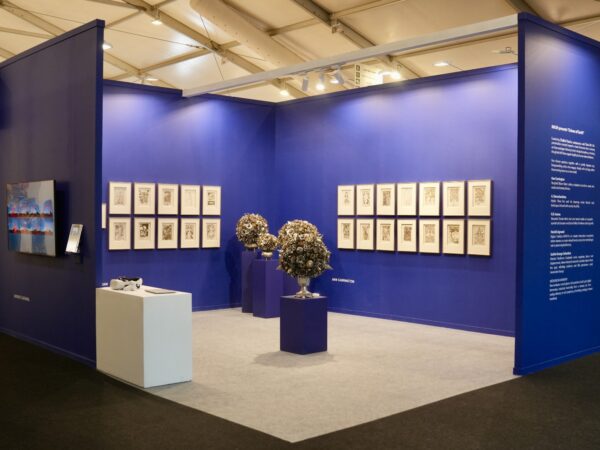
At MASH, we’ve selected 12 standout booths that captured our attention at Art Basel Basel 2025.
1. Gladstone Gallery ( New York, Brussels & Seoul)
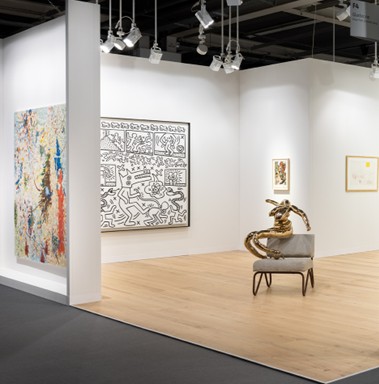
Installation view of Gladstone Gallery’s booth at Art Basel, 2025, Courtesy of Andrea Rossetti Archive
Gladstone Gallery presented a commanding group showcase at Art Basel 2025, blending historical significance with contemporary resonance. A standout was Untitled (1983), Keith Haring’s striking sumi ink on wood that pulsed with his unmistakable visual language.
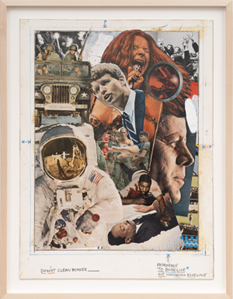
Robert Rauschenberg, Signs, 1969, Courtesy of Gladstone Gallery
The presentation also included Robert Rauschenberg’s politically charged collage Signs (1969), originally conceived as a cover for Newsweek, and Sigmar Polke’s Untitled (1998), which deployed his signature raster technique to interrogate mass media imagery.
Among the newer works, Alex Katz’s floral canvas Lilies 11 (2025) radiated clarity and boldness, while Anicka Yi’s mixed-media §†RñRñK§ (2025), shown in tandem with her UCCA Beijing solo show, offered a conceptual counterpoint. David Salle’s Talk Therapy (2025) interwove abstraction and figuration into a cinematic, psychologically rich tableau. The gallery’s presentation also spotlighted works by Rosemarie Trockel, Anna Zemánková, Salvo, and Andro Wekua—all tied to recent or upcoming solo shows across Gladstone’s global spaces. Additional featured artists included Richard Aldrich, Ed Atkins, Matthew Barney, Joan Jonas, Karen Kilimnik, Hao Liang, Marisa Merz, Rachel Rose, Jill Mulleady, Ugo Rondinone, Amy Sillman, Carrie Mae Weems, and Joseph Yaeger, making this one of the fair’s most expansive and intellectually layered booths.
2. Esther Schipper ( Berlin, Paris, Seoul & New York)
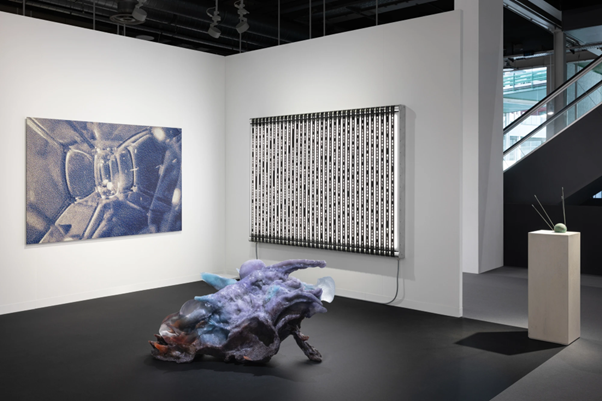
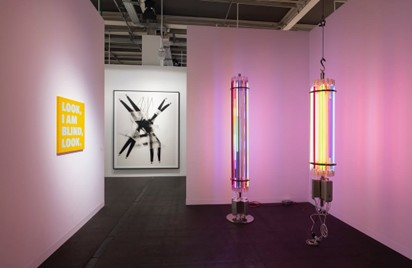
Installation View of Esther Schipper’s booth at Art Basel 2025, Courtesy of Andrea Rossetti Archive
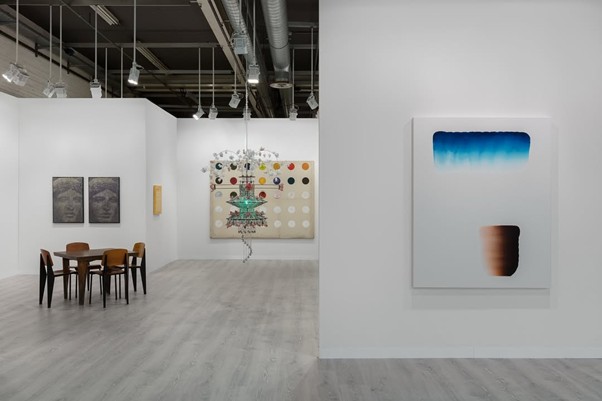
Berlin-based Esther Schipper returned to Art Basel 2025 with one of the most conceptually refined booths of the fair, organizing its presentation into three themed curatorial selections: Black & Light, Color & Space, and Memory & Landscape. Each section offered a distinct visual and emotional register, showcasing the gallery’s commitment to intellectual and aesthetic precision across mediums.
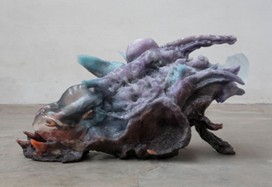
Pierre Huyghe, Mind’s Eye (FY), 2021, Courtesy of Gallery
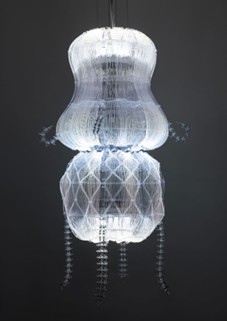
In Black & Light, stark elegance met experimental materiality. Anicka Yi’s animatronic, light-filled sculptures with glowing tendrils captivated audiences alongside Lee Bae’s gestural brushwork in charcoal ink. Rosa Barba’s kinetic “cinematic painting”—constructed from illuminated, moving film—shared a visual conversation with Philippe Parreno’s flickering black lamp installation. Works by Etienne Chambaud, Ryan Gander, Prabhavathi Meppayil, and Julia Scher explored the interplay of materiality, reflection, and perception, each subtle in presence yet conceptually layered.
Anicka Yi, Misty Notions, 2025, Courtesy Of Gallery
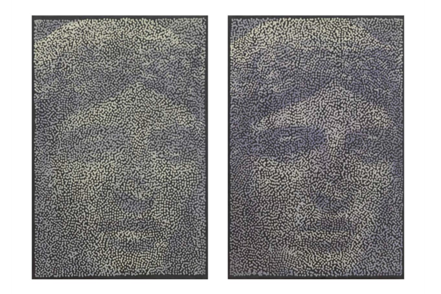
Color & Space unfolded as a vivid, immersive encounter with chromatic energy. Angela Bulloch’s spatially animated sculpture and Simon Fujiwara’s monumental Who-themed triptych reimagined narrative through color and form. Merikokeb Berhanu, Norbert Bisky, Sojourner Truth Parsons, Annette Kelm, and Matti Braun contributed works that traversed the emotional and surreal—ranging from dreamlike landscapes to hyperreal photography and neon-saturated silks. Meanwhile, Memory & Landscape bridged geography and introspection, with standout contributions from Pierre Huyghe, Tauba Auerbach, Ugo Rondinone, Karolina Jabłońska, Anri Sala, and Julius von Bismarck. Their works spanned myth, memory, and materiality—some created in collaboration with AI, others drawn from nature’s quiet textures. Tomasz Kręcicki, Roman Ondak, David Claerbout, Stefan Bertalan, and Martin Boyce deepened this thread, presenting pieces that probed personal and collective memory through sculpture, painting, and film.
Esther Schipper’s presentation at Art Basel 2025 exemplified the gallery’s reputation for cross-disciplinary depth, poetic form, and curatorial clarity, offering a meditative pause amid the fair’s fast pace.
3. Lisson Gallery (London, New York, Los Angeles, Shanghai, and Beijing.)
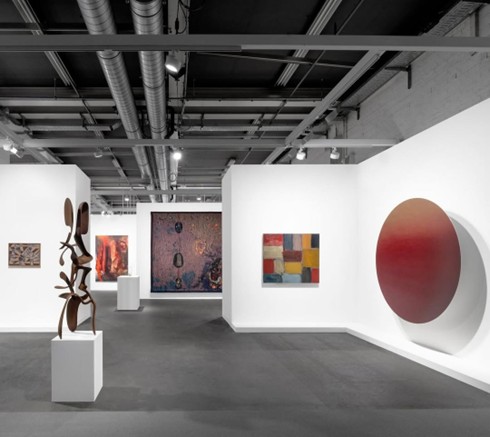
Installation View of Lisson Gallery’s booth at Art Basel, Basel, 2025
Founded in 1967 and based in London, New York, and beyond, Lisson Gallery returned to Art Basel 2025 with a dynamic presentation of new and historical works that reflected the gallery’s expansive, intergenerational program. Spanning painting, sculpture, installation, and performance, the booth featured iconic names and emerging voices, while a monumental presentation by Lee Ufan at Art Unlimited anchored the gallery’s presence with quiet power. His new work Response (2025), composed of sweeping gestures in acrylic, explored his meditative concept of the “encounter”—a visual pause that marks the presence of both artist and viewer in time and space.
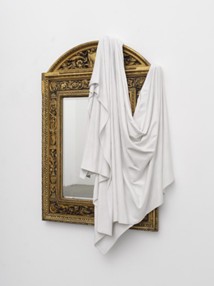
Ryan Gander, I be... (lxxxi), 2024, Courtesy of Gallery
Booth highlights included Sean Scully’s Wall of Light Tappan, 12 (2022), a luminous abstraction that evokes spiritual reflection through monumental form and delicate brushwork, and Carmen Herrera’s Untitled (1948), an early acrylic on burlap painting from her Paris years, pulsing with rhythmic tension and crisp minimalism. Otobong Nkanga’s vast tapestry Cadence – Teardrop (2025) brought the booth into cosmic and ecological terrain with its layered forms, veiled imagery, and themes of visibility and disruption—complementing her ongoing exhibitions at MoMA and the Nasher Sculpture Center. Dalton Paula’s Xica Manicongo (2025), part of his Afro-Brazilian historical portrait series, powerfully reimagined erased narratives with gold leaf and oil, ahead of his debut solo in New York this September.
Anish Kapoor, Untitled, 2012
Anish Kapoor’s optical and visceral works deepened the gallery’s material investigations—Gold to Burgundy Over Gold Satin (2025), a concave mirror painted in pigment and aluminum, drew viewers into its void, while Untitled (2012) channeled raw intensity through its ritualistic layering. Sculptural highlights included Olga de Amaral’s Lienzos C y D (2015), ethereal in gesso and acrylic; Tunga’s magnet-charged Untitled (Case) (2008–2012), blending performance and matter; and Kelly Akashi’s Merletto Ritratto (Lace Portrait) (2024), fusing glass, bronze, and lace into a meditation on time and touch. Works by Leiko Ikemura (Female Genesis, 2016), Wael Shawky, Yu Hong, Allora & Calzadilla, Pedro Reyes, Carolee Schneemann, Oliver Lee Jackson, Laure Prouvost, and Tishan Hsu enriched the presentation with deeply personal, politically attuned, and formally inventive perspectives. From Stefan Bertalan’s cosmological studies to Hélio Oiticica’s vibrant geometric experimentations, Lisson’s booth merged history, identity, and materiality into a powerful reflection of contemporary consciousness.
4. Edel Assanti ( London)
Installation View of Edel Assanti’s booth at Art Basel, Basel, Courtesy of Gallery
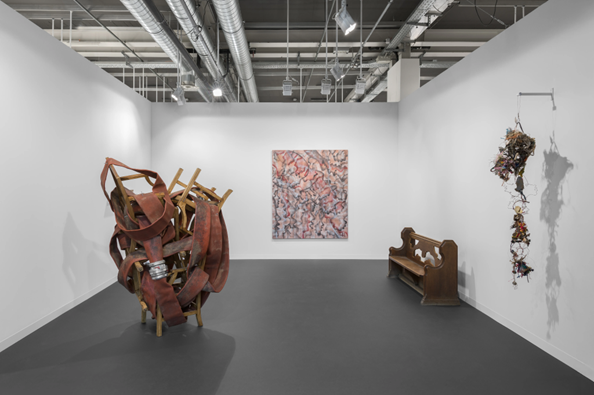
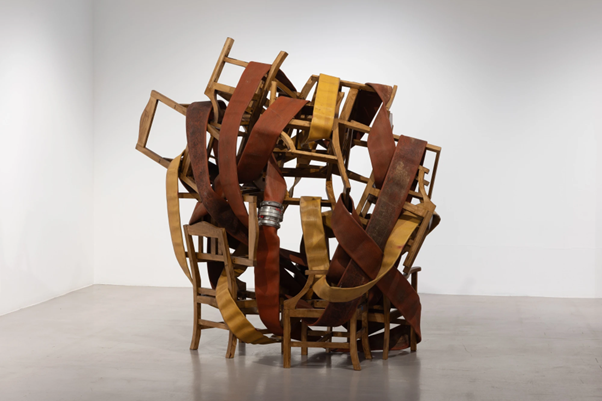
London-based Edel Assanti made a powerful impact at Art Basel 2025 with dual solo presentations by celebrated American artist Lonnie Holley, featured across both the Premiere and Unlimited sectors. The booth in Premiere offered a deeply moving and interconnected suite of sculptures, assemblages, and paintings created by Holley over the past five years. These works navigated themes of social justice, ancestral memory, and the complexities of Black identity in America, drawing from the artist’s lived experiences and cultural inheritance.
Lonnie Holley, Without Skin, 2024, Courtesy of Gallery
Holley—an improvisational force whose practice spans four decades and encompasses sculpture, painting, music, and film—is widely recognized as a pivotal figure in the Black Art tradition of the American South. His work reflects on the trauma of the Jim Crow era, the victories and vulnerabilities of the Civil Rights movement, and the myths surrounding social mobility in the United States. This year marked a milestone in his career with the release of his fifth studio album Tonky and the publication of his first major monograph by Rizzoli, featuring texts by Harmony Holiday and John Beardsley.
Holley’s growing global recognition has been underscored by recent exhibitions at the Camden Art Centre and Royal Academy of Arts in London, as well as at The Met and the Whitney Museum in New York. His work has also entered prestigious public collections including the Centre national des arts plastiques and Kadist in Paris, and the Norton Museum of Art in Florida. With a bold and poetic presence at Art Basel 2025, Edel Assanti’s presentation offered a searing and soulful lens into Holley’s evolving practice—firmly establishing him as one of the most vital voices in contemporary American art.
5. Von Bartha ( Basel & Copenhagen )
Installation view of von Bartha’s booth at Art Basel, Basel 2025
For Art Basel 2025, von Bartha presented a compelling curated booth titled Re-Actions!, which examined how art acts not only as a mirror of its time but as an active response to shifting social, political, and economic forces. Drawing from the gallery’s roots in mid-20th-century avant-garde practices, the presentation reflected on the evolution of conceptual art—from its historically rigid frameworks to today’s more fluid, interdisciplinary approaches.
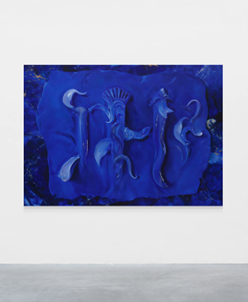
Francisco Sierra, Lazuli, 2025, Courtesy of the Gallery
The presentation skillfully bridged eras and ideologies, pairing historic voices with contemporary interventions. Modern masters such as Barry Flanagan, Camille Graeser, László Moholy-Nagy, Ted Stamm, and Sascha Wiederhold provided a foundation of formal and theoretical rigor. These works were brought into dynamic dialogue with newer contributions from Marina Adams, Imi Knoebel, Landon Metz, Francisco Sierra, Erin Shirreff, and Claudia Wieser, each of whom engages with abstraction, materiality, or spatial experimentation in fresh and unexpected ways.
The booth’s strength lay in its ability to collapse time, showing how the radical strategies of the past echo in today’s practices—while also highlighting how contemporary artists reframe those legacies through today’s expanded lens. Re-Actions! captured von Bartha’s curatorial ethos with clarity and ambition, underscoring the gallery’s ongoing commitment to both historical depth and present-day resonance.
6. Mai 36 Galerie (Zurich)
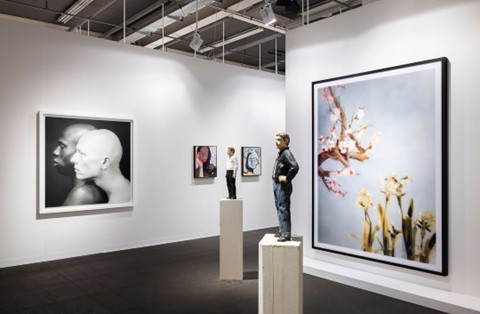
Installation view of Mai 36 Galerie’s booth at Art Basel, Basel 2025
Installation view of Mai 36 Galerie’s booth at Art Basel, Basel 2025
Mai 36 Galerie returned to Art Basel 2025 with a tightly focused yet resonant presentation that emphasized the enduring impact of the photographic image and its dialogues with material experimentation and abstraction. Anchoring the booth was a large-scale canvas from Thomas Ruff’s latest series expériences lumineuses, a continuation of his investigations into light and perception, presented in tandem with the gallery’s exhibition in Zurich during Art Weekend.
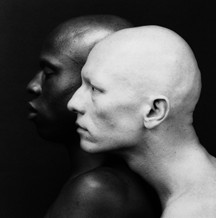
Robert Mapplethorpe, Ken Moody and Robert Sherman, 1984
A special highlight was an oversized print of Robert Mapplethorpe’s iconic Ken Moody and Robert Sherman (1984), a haunting double portrait that reaffirmed the timeless power of black-and-white photography. The presentation deepened with emotionally charged and historically significant works by Peter Hujar and Paul Thek, close friends and collaborators whose practices explored vulnerability, intimacy, and mortality.
Also on view were works by Irma Blank, whose gestural language straddles drawing and writing; a selection of suede-based paintings by rising British artist Poppy Jones; and a contemplative new portrait by German painter Magnus Plessen. Making their Art Basel debut with Mai 36 were sculptures by Swiss artist Raphael Hefti, known for his alchemical processes with industrial materials, and Dutch artist Magali Reus, whose meticulously constructed forms blur the line between the familiar and the enigmatic
7. White Cube Gallery ( London, Hong Kong, Paris, New York and Seoul. )
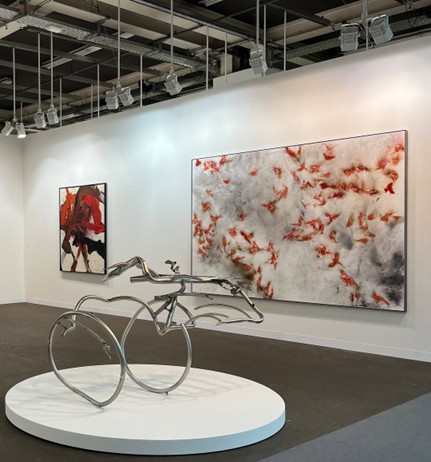
White Cube returned to Art Basel 2025 with an assured presentation that balanced curatorial clarity with powerhouse appeal, bringing together a diverse constellation of established and emerging artists. Featuring works by Peter Doig, Michael Armitage, Cai Guo-Qiang, Tracey Emin, Georg Baselitz, Richard Hunt, Julie Mehretu, Ibrahim Mahama, Sam Gilliam, Alia Ahmad, Robert Irwin, Isamu Noguchi, Mona Hatoum, Lynne Drexler, Enrico David, Kazuo Shiraga, and others, the booth offered a layered and resonant visual experience that moved seamlessly between abstraction, figuration, and material experimentation.
Installation View of White Cube’s booth at Art Basel, Basel 2025
Cai Guo-Qiang’s signature gunpowder paintings captured the duality of destruction and creation, offering explosive lyricism in dialogue with more restrained but equally potent works by fellow Art Basel Award recipients David Hammons and Ibrahim Mahama. Inside the booth, Peter Doig’s luminous Hill Houses (Green Version) (1991) met its echo in Michael Armitage’s barkcloth composition In the garden (2015), a quietly electric pairing that spoke to lineage, admiration, and cross-cultural storytelling.
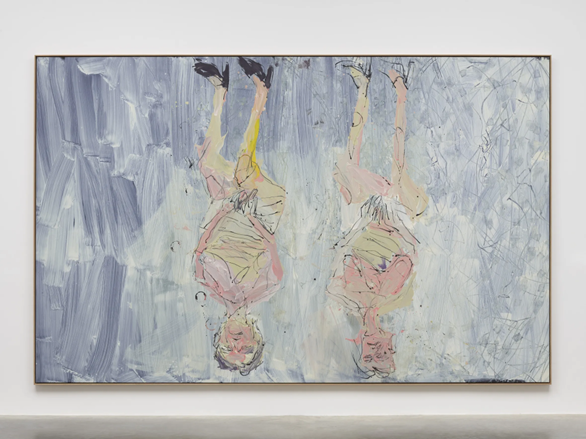
Georg Baselitz, Oh ho, siamo ritornati, am deutschen Wesen, Weltgenesungsbild (Oh ho, Siamo ritornati, through the…, 2023
Tensions and harmonies were carefully choreographed throughout the space: Richard Hunt’s twisting metal form conversed with Julie Mehretu’s graphic paper work, while Sam Gilliam’s 1972 canvas pulsed with the same energy found in Alia Ahmad’s Drifter 2 (2025), a bold new work by the rising Bahraini painter. A strong sale on VIP day, including Georg Baselitz’s Oh ho, siamo ritornati, am deutschen Wesen, Weltgenesungsbild (2023) for €2.2 million, only reinforced the market’s enduring appetite for the gallery’s blue-chip program
8. Experimenter ( Kolkata )
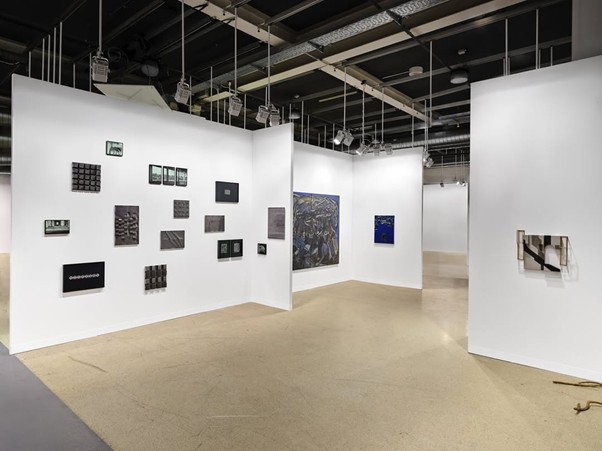
Kolkata- and Mumbai-based gallery Experimenter returned to Art Basel 2025 with a thoughtful group presentation that underscored its commitment to politically engaged and materially rich practices. Showcasing a diverse cohort of 13 artists, the booth delved into themes of memory, migration, identity, and environmental reflection, making it one of the most conceptually cohesive presentations of the fair.
Installation view of Experimenter’s Booth at Art Basel, Basel 2025
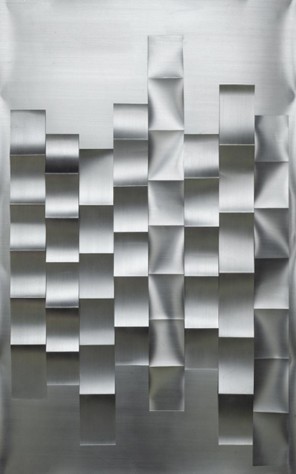
Among the highlights was Ayesha Sultana, whose graphite-on-paper works explored visual memory through intricate mark-making and spatial structures. Sultana, who also designed the facade for India Art Fair 2025, presented drawings where textured graphite surfaces appeared metallic, blurring the line between two- and three-dimensional form. Christopher Kulendran Thomas’s AI-assisted paintings stood out for their inquiry into manipulated histories and digital reconstruction of art narratives, particularly in the context of post-civil war Sri Lanka. Meanwhile, Krishna Reddy’s pioneering viscosity printing was represented through prints that radiated technical mastery and deep experimentation in form and texture.
Ayesha Sultana, Untitled, 2025
Praneet Soi unveiled a new sculptural work referencing mythological double-headed birds, crafted from hand-cut birch blocks inspired by Kashmiri geometry and craftsmanship. T. Vinoja, drawing from her own experiences in post-war Sri Lanka, presented textile works that intertwined land and body as shared sites of trauma and resilience. Biraaj Dodiya’s mixed-media collages traced a cryptic visual geography, layering personal photographs with spontaneous water-based gestures to suggest emotional cartographies of fragmentation and connection.
In his new works, Vikrant Bhise focused on Chembur’s Siddharth Colony, a historic Dalit neighborhood in Mumbai, rendered entirely in ‘Royal Blue’ to evoke both dignity and political resistance. Bhasha Chakrabarti addressed global capitalism and ecological decay in Oceanic Feelings, a triptych made from discarded textiles and ship portholes collected from South Asian shipbreaking yards. Other standout works included Rathin Barman’s architectural concrete reliefs inspired by North Kolkata’s colonial homes; Julien Segard’s poetic depictions of forgotten urban zones; Adip Dutta’s bronze sculptures of overlooked objects from Kolkata’s nightscape; and T.Vinoja, Merikokeb Berhanu, and Sojourner Truth Parsons who added lyrical depth to the booth through personal and place-based explorations.
9. Kukjee Gallery (Seoul )
Installation View of Kukje Gallery’s booth at Art Basel, Basel, 2025
A cornerstone of Korea’s contemporary art scene, Kukje Gallery—founded in 1982 by Hyun-Sook Lee—returns to Art Basel 2025 with a powerful presentation that bridges generations, geographies, and genres. Since relocating to Seoul’s Sogyeok-dong in 1987, the gallery has played a pivotal role in promoting both pioneering Dansaekhwa masters and leading voices in global contemporary art. This year’s booth brings together a wide-ranging lineup, including major works by international figures such as Anish Kapoor, Jenny Holzer, Jean-Michel Othoniel, Julian Opie, and Daniel Boyd, shown alongside Korean luminaries like Park Seo-Bo, Lee Ufan, Ha Chong-Hyun, Lee Seung Jio, and Kwon Young-Woo.
The presentation also includes contributions from a dynamic generation of contemporary artists including Haegue Yang, Korakrit Arunanondchai, Suki Seokyeong Kang, Kyungah Ham, Kim Yong-Ik, Gimhongsok, Sungsic Moon, and Koo Bohnchang. Sculptural and photographic works by Kim Yun Shin, Kibong Rhee, and Jae-Eun Choi deepen the material and conceptual range of the booth, while SUPERFLEX’s socially charged interventions underscore the gallery’s engagement with pressing global issues.
Daniel Boyd, Untitled (HCBNMTLIR) / Untitled (BFWTFA), 2025
Kukje Gallery’s sales were led by Lee Ufan’s Dialogue (2021), which sold in the range of $900,000–$1.08 million. Other key sales included Elmgreen & Dragset’s Boy with Drone (Black Bronze) (2025) (€230,000–€276,000), Ha Chong-Hyun’s Post-Conjunction series (multiple works between $176,000–$303,600), Jenny Holzer’s What’s This (2024) ($185,000–$222,000), Kibong Rhee’s Illusion Code from Zero (2025) ($100,000–$120,000), and Kim Yun Shin’s Add Two Add One, Divide Two Divide One (1998) ($85,000–$102,000). Additional works by Lee Seung Jio, Suki Seokyeong Kang, Julian Opie, Jae-Eun Choi, Kyungah Ham, Sungsic Moon, Koo Bohnchang, Jean-Michel Othoniel, Yun Shin, and SUPERFLEX sold in the five-figure range—reflecting robust collector interest across the board.
10. Galerie Nordenhake (Berlin, Mexico City, Stockholm )
Installation View of Galerie Nordenhake ‘s boot at Art Basel, Basel 2025, Courtesy of Sebastiano Pellion di Persano
With spaces in Berlin, Stockholm, and Mexico City, Galerie Nordenhake brings to Art Basel 2025 a carefully curated presentation that underscores its longstanding commitment to artists working across diverse conceptual and formal vocabularies. Founded in 1976 in Malmö by Claes Nordenhake, the gallery is known for its sustained and collaborative representation of intellectually rigorous artists at various stages in their careers.
Frida Orupabo, Of course everything is real, 2024
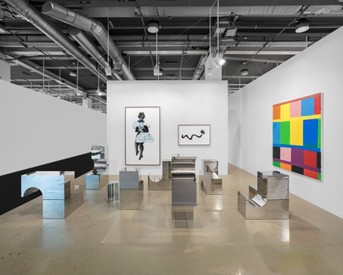
This year’s booth is anchored by Frida Orupabo and Frida Escobedo, whose practices share a compelling interplay of form, history, and perception. Escobedo’s striking new installation Cube 01—a set of modular stainless steel sculptures exploring the geometry of the cube within a circle—serves as the gravitational center of the presentation. Reflective and dynamic, the sculptures interact with the surrounding works and viewers alike, echoing the ephemeral nature of perception.
Orupabo’s contributions include a series of powerful new paper collages and two installations previously shown at Bonniers Konsthall and Astrup Fearnley Museum, extending her incisive exploration of race, gender, and archival imagery. These anchor a group presentation featuring key works by Torsten Andersson, Spencer Finch, Yngve Holen, Ryan Mrozowski, Patricia Treib, and Stanley Whitney, among others—together creating an open, dialogic layout that dissolves borders between individual expressions and collective resonance.

 MASH
MASH